

Here’s how my first month as a manager went: one task was late, so at 9pm I opened my laptop and fixed it myself. The person who owned that task wasn’t doing anything about it. Not because they were lazy - because I never told them it was urgent. I just did their job for them, the same way I had done my own job for years. Then I went to bed feeling productive.
This is not a leadership philosophy piece. I don’t have a natural gift for managing people, and I’m not going to pretend I’ve solved it. What I had, a few months into managing a team for the first time, was a smaller problem, and an easier one to fix: I was still doing my old job, just with a new title. So I did what any engineer does when something doesn’t work - I looked for the model behind it.
The equation
My manager at the time gave me a book called High Output Management, written by Andy Grove, who used to run Intel. Early in the book is one idea that changed how I thought about the job:
Manager’s Output = Your Output + Your Team’s Output + Output of the People You Influence
the core idea behind Andy Grove’s High Output Management
Broken into pieces, it looks like this:
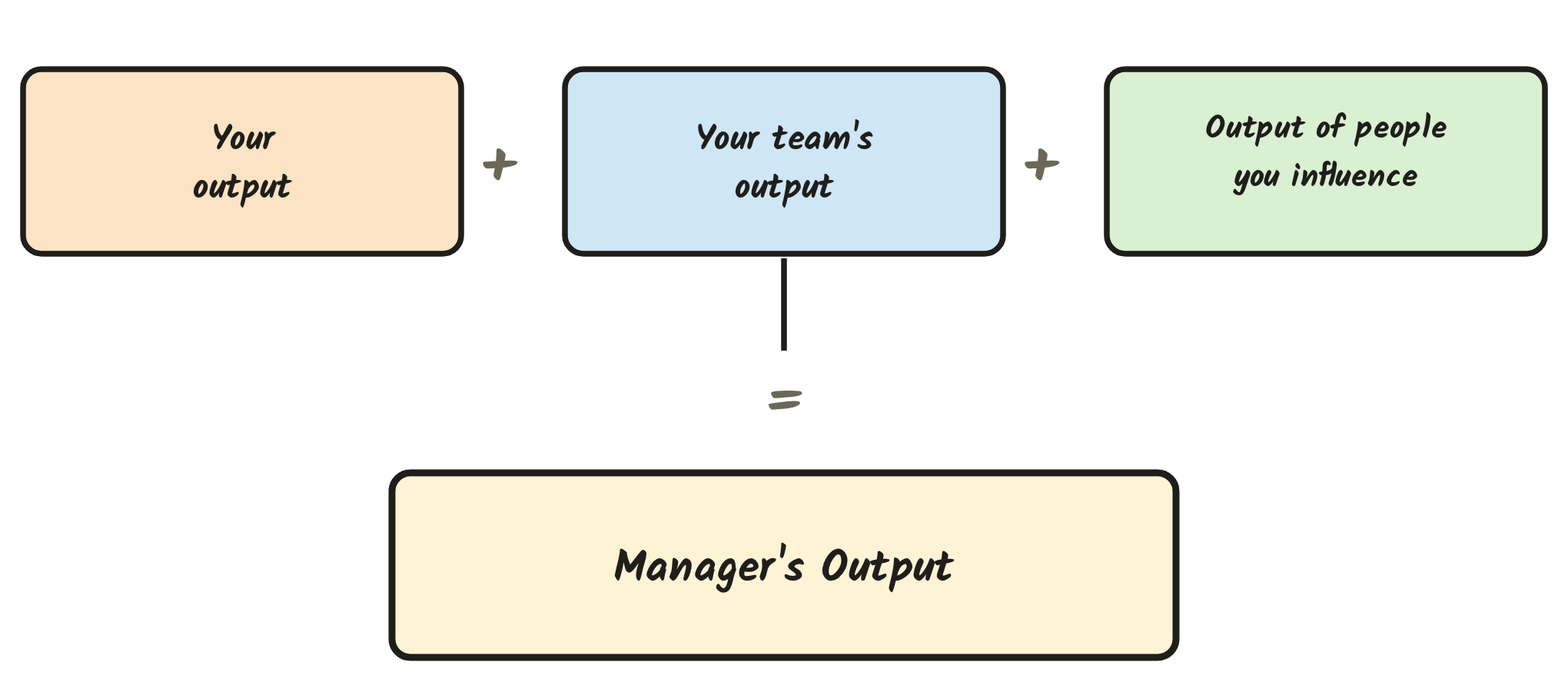
That’s the whole shift. My old job only had one input. This one has three. The extra tasks I’d stacked on top of my old job - 1:1s, approvals, trying to be a good boss - were real, but they weren’t the job itself. The job is growing the whole right side of that equation, and my own work is just one small piece of it.
Same 40 hours, different lever
Nobody gets extra hours when they get promoted. Five days a week, about eight hours a day - same as everyone else, with some exceptions by industry. What changes is how you use those hours. As an individual contributor, I only had one lever: my own time. As a manager, I have three levers. But I only fully control one of them.
So the real question isn’t “what should I work on.” It’s “my time affects the most people on this team - so what’s the best use of the next hour.” The answer changes depending on the week.
The fork: war mode or build mode
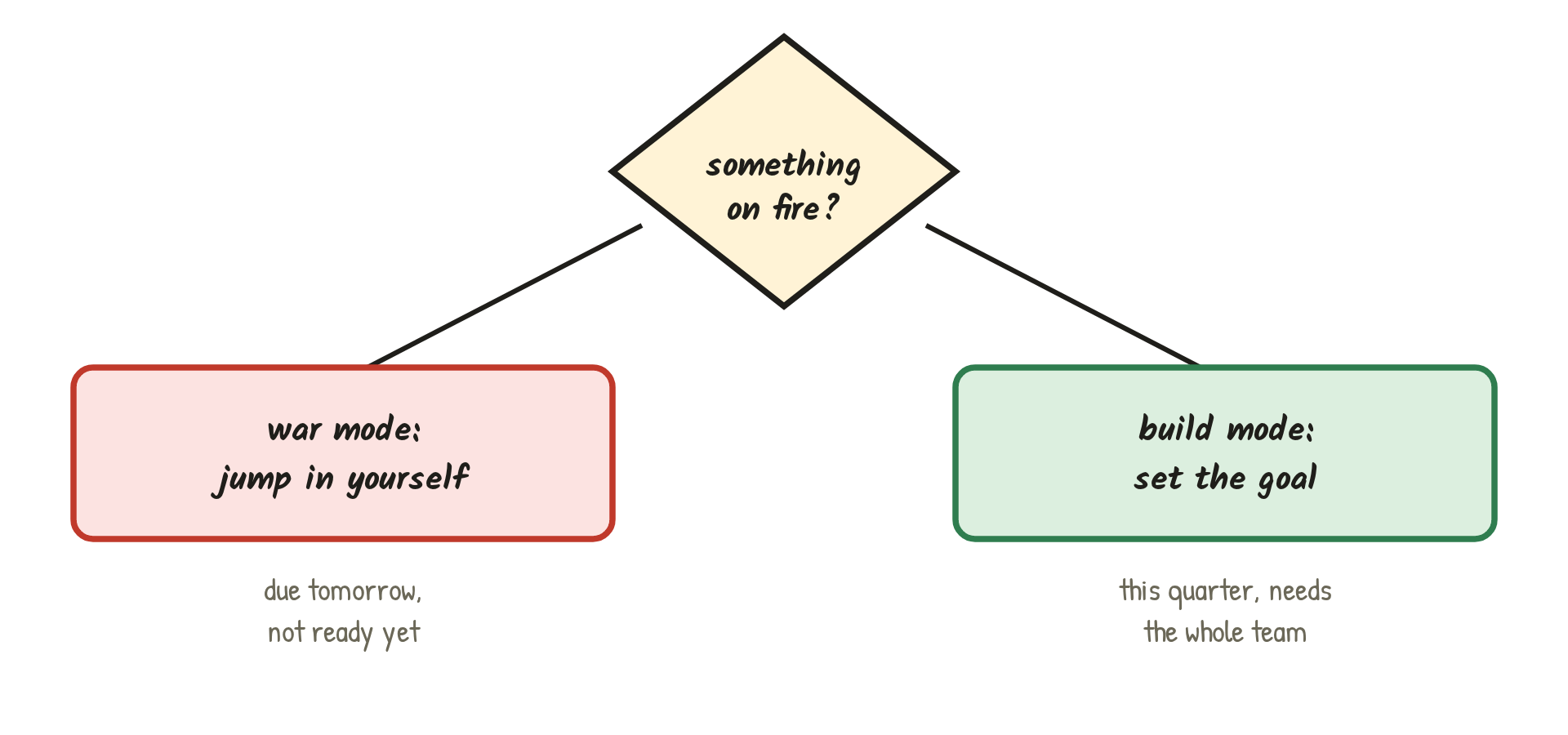
Some weeks the answer is easy: do the work yourself. If something is due tomorrow, and the person who owns it isn’t ready for it yet, that’s not a moment for coaching - that’s a fire. The best move is to jump in, get it done, and talk about it afterward.
But most weeks are not on fire. Most weeks are about medium-term goals - things that only get done if the team works well together, without me watching every task. On those weeks, the best use of my time is something boring: sitting down and setting the goals properly.
Worked example: splitting a goal without splitting the team
Here’s what this looks like in real life. Say my goal is number of sales. That number depends on many things, and I don’t control all of them. I can’t just give my team the goal “grow number of sales” - it’s too vague to act on. So I break it into smaller parts. For example, I split it into two teams: one team handles traffic, the other handles conversion.
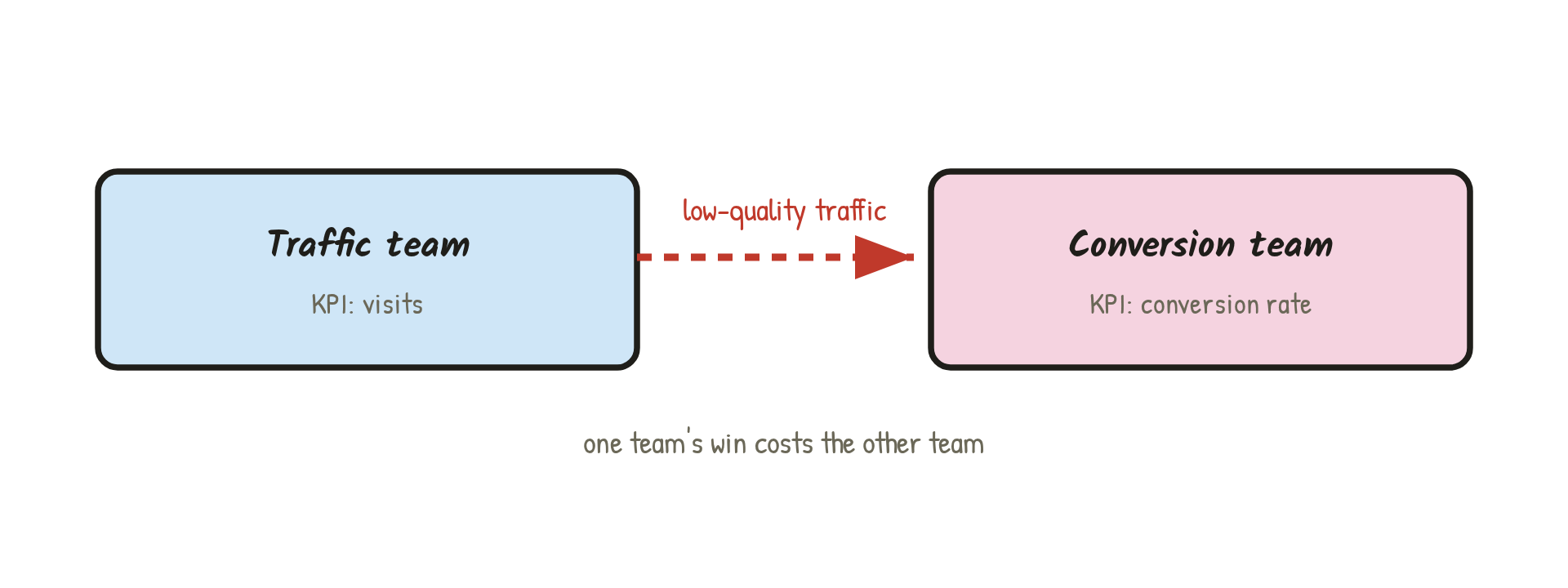
This looks clean on paper. But in real life, it leaks. If the traffic team brings in a lot of low-quality visitors just to hit their number, the conversion team’s numbers will drop - even though it isn’t their fault. One team’s decision quietly hurts the other team’s KPI.
The straightforward fix is to add “traffic quality” to the traffic team’s goal, so volume alone isn’t enough to win. This is the right idea. But it also costs more. Now someone has to define what “quality” means, measure it well, and defend that definition when people disagree. So before doing this, I ask myself: do we actually have the time and people to measure this well? Is this the best use of our time right now?
Sometimes, the honest answer may be no - not yet with the currently limited resources we have. If that were the case, a practical choice would be: accept that the two goals depend on each other. Don’t pretend the numbers are more accurate than they really are. Instead, use two simpler tools - a general sense of whether things are moving in the right direction, even without a perfect number, and regular check-ins between the two teams, so problems get caught early instead of at the end of the quarter. Bigger companies can usually afford more precise measurement. Smaller ones usually can’t. Forcing precision you can’t afford just wastes the time you were trying to save.
One check I always run: if every team hits their number exactly, does the overall goal actually get reached? If I can't answer "yes" with confidence, the breakdown is incomplete - there's a gap I haven't accounted for. That gap is worth finding before the work starts, not after.
One more caveat: this example assumed traffic and conversion both report to me. In practice they often don't - one might sit in marketing, the other in product. Getting a peer's team to act on something you can't assign to them is a different skill than running your own team.
Say it until they don't need you to
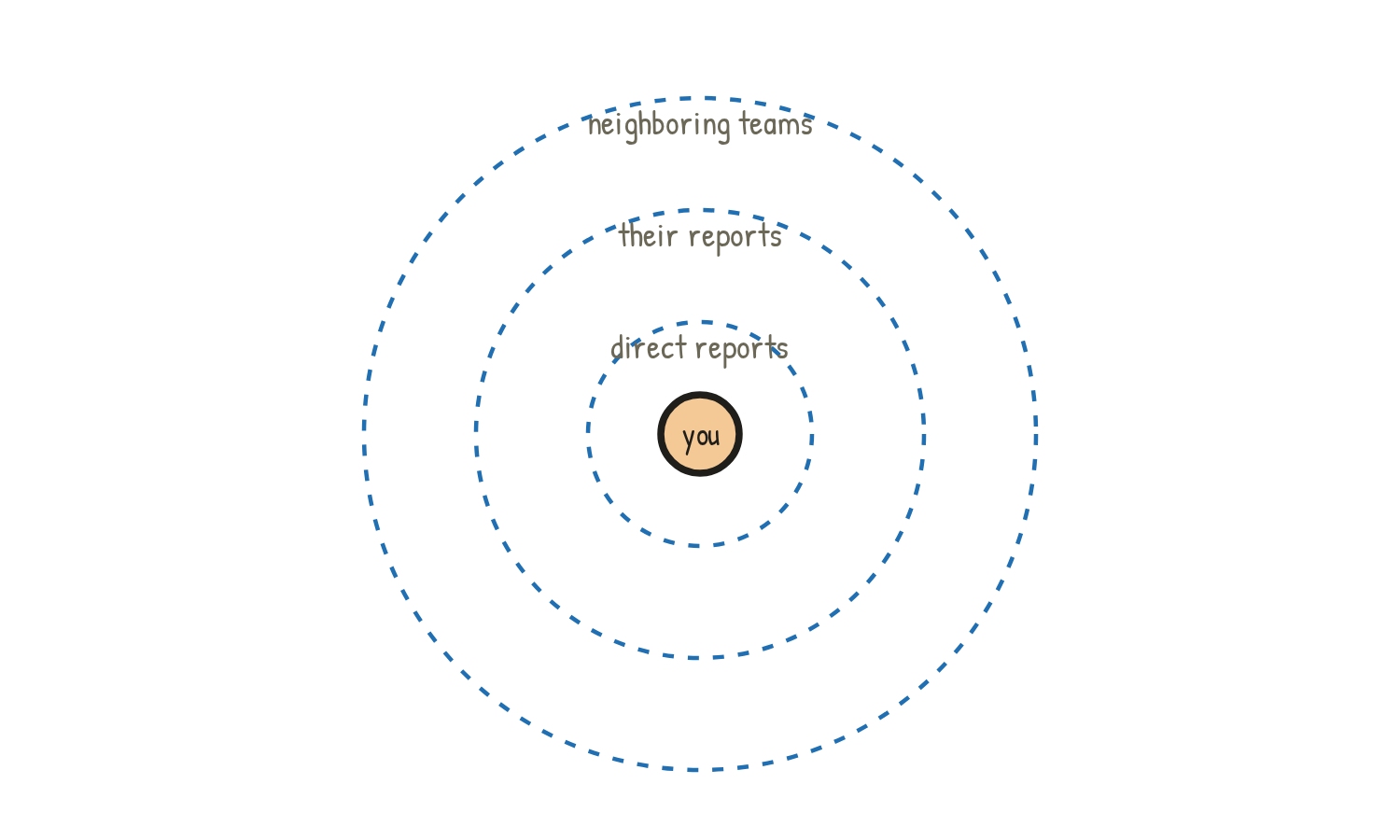
None of this matters if it stays in my head. Once the plan is set, my job becomes mostly repetition: say the goal, say it early, and say it again - to my direct reports, to their reports, and to other teams whose work touches mine. Again and again, until people can state both what the goal is, and what it isn’t, on their own.
Repeating the goal only proves people can say it back. It doesn't prove they understand it. And usually, you can't tell the difference. People get by on habit, or on copying whatever worked last time, and it looks exactly like understanding, right up until something ambiguous shows up. A new situation, a tradeoff nobody’s hit before. There's nothing to copy from anymore. That’s the actual test: can someone take an option they’re weighing and tell you, unprompted, whether it moves the goal or not? If they can’t yet, sometimes a question is enough - “does this move the goal?” Sometimes it isn’t, and I have to sit down and walk through the comparison myself, out loud, so they see the reasoning, not just the answer.
What the equation doesn't measure
The equation tells you your output, right now, this year. It doesn’t tell you where that output is coming from, or whether it can keep coming.
Behind the three inputs - your output, your team’s output, output of the people you influence - sits something the equation never asks about: is your team improving or burning out? Do people trust each other, or are they quietly checked out? Are people staying, or updating their resumes? Is the way you work together getting better, or is every project reinventing the wheel?
This runs in the background all the time, this year included, and it cuts both ways. A team can push hard, ignore the strain, and still hit this year’s number - burnout and low trust don’t stop you from delivering right away, they just cost you later. The same delay applies to investment: make the team stronger, build trust, fix how you work together - sometimes that shows up in this year's numbers, sometimes it doesn't. Either way, most of the benefit - a stronger team, getting more done, without you needing to do more yourself - is more likely to show up next year than this year.
If you’re in survival mode - this year has to work, or there’s no next year - you don’t need to think about this. Hit the number. That’s the job.
If you’re playing the long game, though, there’s more to manage. The background needs to hold, not break. And separately, if you want next year’s number to be bigger, that’s where the investment goes. Neglect either one long enough, and it eventually shows up as a smaller number - but not this year, and not in a way anyone will trace back to the cause. By the time it’s visible, it just looks like the team “isn’t performing” the way it used to.
PEOPLE & PROCESS BUILD NEXT YEAR'S OUTPUT
This piece was really just about the setup - the equation, splitting goals, saying them out loud. A few things I didn’t get into:
What actually happens day to day once the goal is set
The people side - trust, morale, how to actually grow team members
How to get people who don’t report to you to actually do something
Each one probably deserves its own post.
I wrote this down mainly as a reminder to myself - something to check in five years, to see if the learning still holds up.